

Ahead of Lesbian Visibility Week, we take a look at why our community has higher rates of poor mental health
BY NANCY KELLEY, IMAGE BY PEXELS
As with so many other areas of LGBTQIA women and non-binary people’s lives, there isn’t nearly enough research into the mental health needs of our community.
But the evidence that does exist makes it very clear that LGBTQIA people have dramatically worse mental health than our cis and straight peers, and that struggling with our mental health is something that can affect us throughout our lives.
The best data we have is from the Adult Psychiatric Morbidity Survey, which sadly doesn’t ask about trans status (something it has in common with the majority of National Statistics). APMS shows us that being lesbian, gay or bi is associated with a range of mental health conditions including depression, anxiety and OCD. It’s also associated with suicide, self-harm and substance misuse.
These differences aren’t small ones: LGBQ+ people are twice as likely to say they’ve been depressed in the last week and we’re twice as likely to report an OCD episode or a phobic episode. Our lifetime risk of both self-harm and suicide is dramatically higher. We’re far less likely to report feeling happy, or even fairly happy.
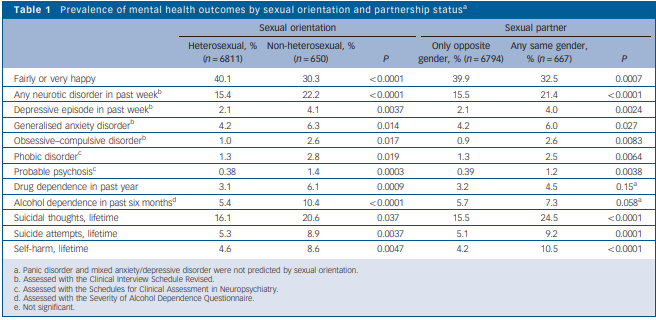
Data: APMS 2007
And despite a culture that increasingly focuses on mental health and wellbeing, the position isn’t improving. Between the two waves of the APMS survey, in 2007 and 2014, there was no improvement at all in LGBQ+ people’s mental health.
The wider evidence base tells us that there are also big variations within our community. Bi-women appear more likely to report poor mental health compared to lesbian women, with some researchers attributing this difference to the experience of ‘double discrimination’.
And trans people experience dramatically worse mental health outcomes. Analysis of data from the GP Patient Survey showed that one in six trans men and women report having a long-term mental health problem, compared to one in ten cis people. Non-binary people are at even higher risk – almost one in two non-binary people reported having a long-term mental health condition.
So LGBTQIA people are significantly more likely to experience mental health problems, and some parts of our community including bi women as well as trans and non-binary people, are at particularly acute risk. Why?
The answer is pretty clear:
- LGBTQIA people are far more likely to have experienced “adverse childhood experiences” including physical and sexual abuse, severe bullying or homelessness. These increase our lifetime risk of experiencing mental distress.
- LGBTQIA people experience day-to-day “minority stress” as a consequence of societal homophobia, biphobia and transphobia. These experiences of discrimination and social exclusion also increase our lifetime risk of experiencing mental distress.
- LGBTQIA people find it harder to access healthcare, and when we do access healthcare, we’re more likely to experience poor service. This means our mental health is at higher risk of deteriorating.
So, we’re a well-known high-risk group for poor mental health, and we know this is caused by experiences of abuse, discrimination, and poor service provision. These things are big priorities for government action, right? Right?
Sadly, this isn’t the case. Too many LGBTQIA children, particularly trans children, still experience discrimination, bullying and abuse at home and at school.
Too many LGBTQIA adults experience daily discrimination and exclusion. Hate crimes targeting our community have been rising for years.
And all too often health services don’t feel safe. Investment in mental health services is woeful, and the prospects of accessing high-quality specialist services as an LGBTQIA person are vanishingly low.
In most places in the world, and for most of modern history, society has believed that LGBTQIA identities are a form of mental illness. This poisonous idea makes our distress somehow expected, accepted, and unsurprising.
It’s not good enough. We deserve to live in safety. And when we can’t – because you’ve hurt us, the very least we should be able to expect is good quality care.
Lesbian Visibility Week
22 April – 28 April 2024
This Lesbian Visibility Week we will be celebrating the power of sisterhood by uplifting incredible LGBTQIA women and non-binary people from every generation, in every field and in every country around the world. One community, so many brilliant individuals. This year we are building on Lesbian Visibility Week’s incredible success with unified not uniform – a global campaign celebrating the power and diversity of our community. As ever, our aims are to build public understanding of LGBTQIA women and non-binary people’s lives, to increase lesbian visibility and to create a legacy that benefits our community everywhere.
You can find out more and get involved at: lesbianvisibilityweek.com

DIVA magazine celebrates 30 years in print in 2024. If you like what we do, then get behind LGBTQIA media and keep us going for another generation. Your support is invaluable.


